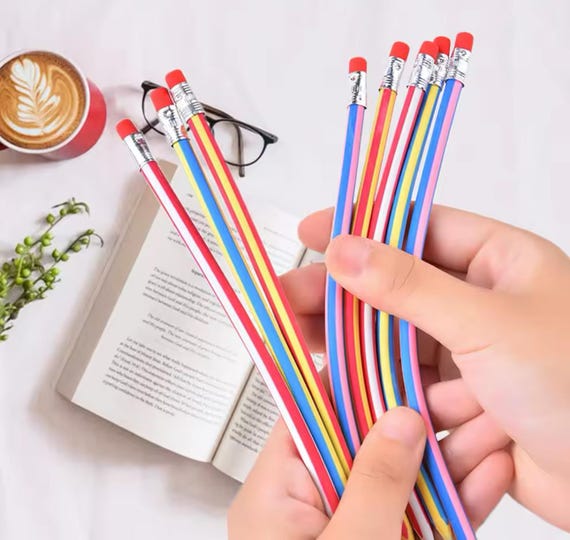
Bendy Pencils: A Flexible Twist on an Everyday Essential
Most pencils are made to stay straight. Bendy pencils are designed to do the opposite: they flex, curve and sometimes twist into amusing shapes. Their unusual appearance makes them popular as novelty items, party favours and small gifts, but not every bendy pencil is intended for writing.
What is a bendy pencil?
“Bendy pencil” can describe a few different products. Some are novelty pencils made with a flexible body, often using soft plastic or rubber-like materials. Others look like ordinary pencils but are designed to flex slightly rather than snap under a small amount of pressure. The materials and construction vary, so it is worth checking the product description if you need a pencil for school or everyday writing.
Many novelty versions are more like playful desk toys than stationery. They may bend easily but have a blunt tip, a non-standard writing core or no usable graphite at all. A pencil that looks bendable is not necessarily suitable for drawing or taking notes.
How do they bend?
A traditional wooden pencil is rigid because its graphite-and-clay core is held inside a firm wooden casing. A flexible pencil uses a different design or material that allows its body to curve without immediately breaking. Depending on the model, it may contain a flexible central core, a soft outer casing, or a series of joined sections.
Flexibility has its limits. Bending a pencil too sharply, twisting it repeatedly or forcing it into a tight knot can damage it. If a pencil is advertised as a novelty, it is safest to treat it as a toy or conversation piece rather than test how far it can stretch.
Why are bendy pencils popular?
- They are entertaining: Their unusual shape makes them an amusing alternative to standard stationery.
- They make memorable gifts: Bendy pencils are often chosen for party bags, classroom prizes and small presents.
- They can brighten a desk: Their playful design adds a touch of colour and personality to a workspace.
- They prompt curiosity: A flexible pencil can lead to questions about materials, design and how everyday objects are made.
Choosing one
Before buying a bendy pencil, consider what you want it to do. For writing or drawing, look for a product that clearly states that it is functional and check what kind of lead it uses. For a novelty gift, appearance and flexibility may matter more than how well it writes.
It is also sensible to check the recommended age, materials and safety information, particularly if the pencil is intended for a young child. Small parts, sharp points and detachable components may not be suitable for everyone.
A playful take on a classic
Bendy pencils give a familiar object an unexpected twist. Some are practical writing tools with a little extra flexibility; others are simply made for fun. Either way, they show how a small change in design can turn an everyday pencil into something that catches the eye.
8 Reasons Bendy Pencils Are a Must-Have: Fun, Flexible, and Full of Colour
- Fun and eye-catching
- Easy to carry
- Great for party bags
- Make playful desk accessories
- Available in bright colours
- Can be flexible and durable
- Encourage creative play
- Make cheerful little gifts
Drawbacks of Bendy Pencils: Practicality and Durability Concerns
- May be harder to write with neatly.
- Can feel awkward to hold.
- May break if bent too far.
- Often less durable than standard pencils.
- Some are novelty items, not practical for writing.
- May not sharpen easily.
Fun and eye-catching
Bendy pencils are fun and eye-catching, turning an everyday stationery item into something a little more playful. Their unusual shape and bright colours can make writing or drawing feel more enjoyable, while helping a pencil stand out in a pencil case or on a desk. They can also make cheerful little gifts or party-bag treats.
Easy to carry
Bendy pencils are easy to carry because their flexible design can make them less likely to snap when packed alongside books, stationery or other everyday items. Slip one into a pencil case or bag for a playful, practical alternative to a standard pencil.
Great for party bags
Bendy pencils make a fun addition to party bags, offering children a colourful surprise that is a little different from the usual sweets and stickers. Their playful, flexible design can keep guests entertained after the party, while their compact size makes them easy to pop into a goody bag.
Make playful desk accessories
Bendy pencils make playful desk accessories, adding a splash of colour and a sense of fun to an otherwise ordinary workspace. Their flexible shapes invite a quick fiddle between tasks, while their quirky appearance can brighten a desk at home, school or work. They’re a simple way to give your stationery a little personality.
Available in bright colours
Bendy pencils are often available in bright, eye-catching colours, making them easy to spot in a pencil case or on a desk. From vivid pinks and blues to cheerful greens and yellows, their colourful designs add a playful touch to everyday writing and can make them especially appealing to children.
Can be flexible and durable
Bendy pencils can combine flexibility with durability, allowing them to curve slightly under pressure instead of snapping as easily as a rigid pencil. This makes them a fun, resilient choice for everyday use, although their strength depends on the materials and design, and they should not be bent beyond their intended limits.
Encourage creative play
Bendy pencils can encourage creative play by inviting children to explore shapes, movement and imaginative ideas. Their flexible design makes drawing and writing feel more playful, while also inspiring children to invent games, characters or stories around this unusual stationery.
Make cheerful little gifts
Bendy pencils make cheerful little gifts for children, classmates and creative friends. Their playful shape and bright colours bring a smile, making them ideal for party bags, classroom prizes or a small surprise. They’re a fun alternative to ordinary stationery and can add a little personality to a pencil case or desk.
May be harder to write with neatly.
Bendy pencils can be harder to write with neatly than standard pencils. Their flexible bodies may move or wobble as you write, making it more difficult to keep the tip steady and form consistent letters. This can be frustrating when taking notes or completing detailed work, so a traditional rigid pencil may be a better choice when neatness matters.
Can feel awkward to hold.
Bendy pencils can feel awkward to hold, especially if their flexible bodies move while you write. This can make it harder to keep a steady grip and control the pencil tip, so writing neatly or drawing precise lines may take more effort than with a standard pencil.
May break if bent too far.
Although bendy pencils are designed to flex, they can still break if bent too far or twisted repeatedly. This may damage the pencil’s casing or writing core, making it difficult or impossible to use, so it is best to bend them gently and follow the manufacturer’s guidance.
Often less durable than standard pencils.
One drawback of bendy pencils is that they are often less durable than standard pencils. Their flexible materials or construction may wear out with repeated bending, and the pencil can become damaged if it is twisted too far or handled roughly. For everyday writing, a traditional pencil may therefore be the more reliable choice.
Some are novelty items, not practical for writing.
Some bendy pencils are designed mainly as novelty items, so they may be less practical for everyday writing. Their flexible bodies can make them awkward to hold and control, while some have blunt tips or unsuitable leads. They may be fun to play with or give as a gift, but it is worth checking that a pencil is actually made for writing before buying one for school or work.
May not sharpen easily.
One drawback of bendy pencils is that they may not sharpen easily. Their flexible material can make it difficult to hold them steady in a standard sharpener, while the casing or lead may bend, tear or break instead of forming a neat point. This can make them less practical than a traditional wooden pencil, particularly when a sharp tip is needed for detailed writing or drawing.